
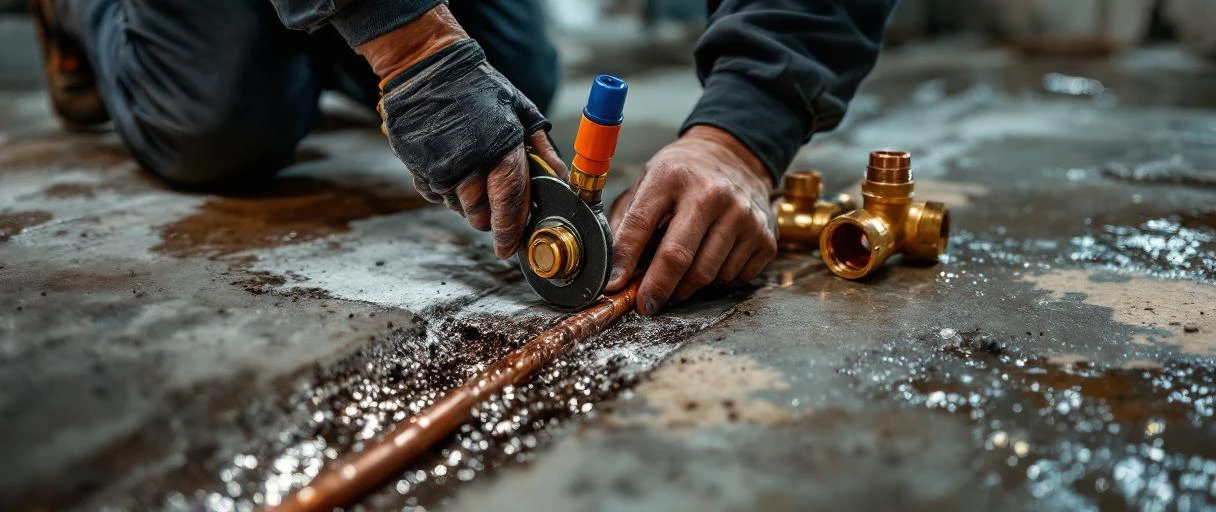
A split copper line is the single most disruptive plumbing call our network runs. Water moves fast, drywall soaks in minutes, and the difference between a $400 fix and a $4,000 restoration is how quickly the main shuts off and how soon a licensed Ohio plumber arrives with the right parts. Burst Pipe Repair Cincinnati OH work is the bread and butter of our overnight dispatch — copper, PEX, galvanized transition, polybutylene whole-house cleanup, and slab-leak rerouting all live under this scope. The fix follows a clean sequence: locate, isolate, drain, cut, replace, pressure-test, document.
How Cincinnati’s Climate Splits Copper and Galvanized Lines
Cincinnati averages roughly 30 freeze days per year, and the freeze-thaw cycle fatigues copper joints over decades even when no single freeze event is severe enough to burst a pipe outright. Soldered joints near uninsulated exterior walls in basements and crawl spaces often fail in spring after a hard winter — the cumulative stress finally lets a 50-year-old joint give. Pre-1980 housing stock concentrated in Northside, Price Hill, Walnut Hills, and Norwood frequently has supply runs in spaces that hover near freezing for days at a time during cold snaps.
Polar vortex events have reached -10°F to -20°F in Cincinnati during recent winters (2014, 2019, 2022, and the early 2025 stretch), pushing freeze risk into spaces that are normally safe — interior bath walls, behind kitchen cabinets, plumbing chases that pass through unconditioned attic space. The broader picture of how our Cincinnati plumbing crew handles every emergency category sits on our main page, with details on licensing, code, and after-hours coverage that apply to every burst-pipe call.
Galvanized supply lines in pre-1950 Cincinnati homes have an inside diameter that narrows from internal corrosion (tubercle buildup) over decades — a “burst” in galvanized is often actually a corroded-through wall rather than a freeze event. The repair scope on galvanized typically extends well beyond the visible failure because the rest of the line is in similar condition. We diagnose with the homeowner before quoting partial replacement on galvanized, since whole-line replacement often makes more sense.
Why Type M Copper Fails
Type M copper installed in Cincinnati between 1960 and 1985 has a typical service life of 50–70 years, with pinhole leaks rising sharply after year 50. The math puts much of the city’s mid-century stock in active failure window now. Cincinnati’s chloraminated water (switched from chlorine in 2015) is gentler on rubber gaskets but slightly more aggressive on copper than free chlorine, contributing to thin-wall Type M failures. Pre-1986 copper installations may also contain lead solder; current code requires lead-free solder on any repair joint, meaning a “small fix” can trigger broader replacement requirements when the existing solder is exposed.
Pinhole leaks are the early-stage form of full burst failure. They start as a small fan of mist or a slow drip and expand into longitudinal splits over months to years. Acoustic and thermal leak detection catches pinholes before they progress.
Spotting a Pipe Failure Before the Damage Spreads
Most burst events announce themselves with visible water — a spray, a drip, a wet spot expanding on drywall. Some don’t. A pipe inside a wall can leak for weeks before staining shows on the visible side. A water meter that spins with all fixtures off is a fast diagnostic for any unexplained loss. A sudden drop in pressure at multiple fixtures simultaneously points to upstream failure on a shared run.
When the line is bulging or showing pinhole spray rather than full rupture, the work shifts toward pre-burst pipe diagnosis with acoustic equipment to confirm the failure point before any cutting begins. Acoustic detectors hear the high-frequency hiss of pressurized water escaping a small opening; thermal imaging cameras spot the temperature differential where water has wet adjacent surfaces. Both equipment types ride on our leak-call dispatch.
A frosted exterior on copper during a cold snap means the pipe inside is partially or fully frozen. The line may not have split yet — that often happens at the thaw, when water pressure returns to a section of pipe that’s been weakened by ice expansion. Recognizing the difference between frozen-but-intact and already-burst changes the response.
Our Step-by-Step Process for Stopping the Leak
The sequence is the same on every burst call. Locate the failure visually or with detection equipment. Shut down the closest upstream valve — main shutoff for whole-house events, branch valve if the line is split into zones, or fixture angle stop for localized leaks. Drain the affected section by opening the lowest downstream faucet so cutting work doesn’t dump water into the workspace. Cut out the damaged section, over-cutting by a clean inch on each end for proper joint preparation.
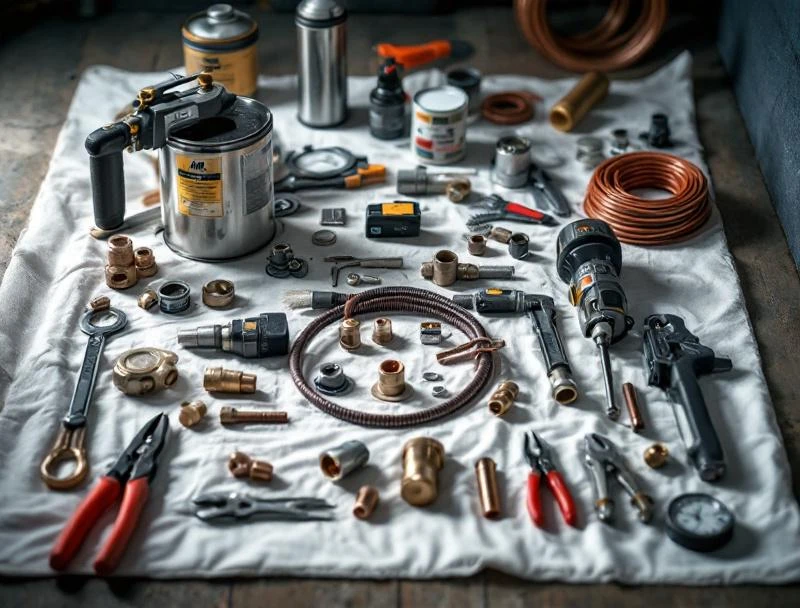
Most active bursts call in outside business hours, which is why our after-hours plumbing service runs around the clock with stocked trucks ready for cut-and-replace work at 3 AM. Trucks carry copper Type L and Type M, red and blue PEX, ProPress fittings, MAPP gas, lead-free solder, and pressure test gauges so first-visit closure is the rule rather than the exception.
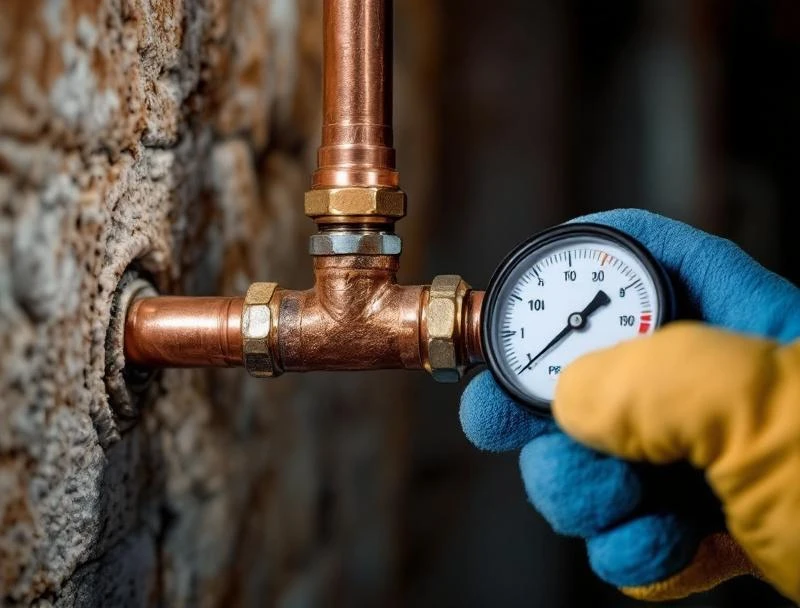
Joint method depends on location and code. Sweat copper joints (MAPP gas, flux, lead-free solder) for traditional repair on accessible runs. ProPress for fast, flame-free joints in tight or fire-sensitive spaces. PEX expansion fittings (Uponor) for transition or whole-room repipe scope. After joining, the line gets pressure-tested at 100 PSI for a minimum of 15 minutes per Ohio Plumbing Code section 312 — most quick-fix shops skip this step entirely.
Copper, PEX, and Galvanized — Material-Specific Fixes
Copper repairs use the existing material when possible. Type L (heavier wall, slab-rated) replaces Type M in failure-window installs because the longer-lived material reduces recurrence. ProPress couplings and elbows install in seconds with the right tool and produce code-accepted joints without an open flame. PEX-A from Uponor with expansion fittings handles transitions where copper is being phased out — a common pattern in whole-room repipes where homeowners move to PEX for cost and freeze tolerance.
Galvanized requires special handling at transitions. Connecting copper directly to galvanized creates galvanic corrosion at the dissimilar-metal joint, accelerating failure. The Ohio Plumbing Code requires dielectric unions at copper-to-galvanized transitions; pre-1986 Cincinnati installs frequently lack them and the failure shows up as an aggressive corroded joint within years.
Polybutylene gray plastic pipe installed 1978–1995 in Cincinnati area condos and townhouses is class-action-settled defective. A burst connection at the heater itself often coincides with corrosion damage at the tank, so our tank replacement service team checks the unit’s age and condition before recommending the line repair scope. Insurance carriers may require full replacement after a single confirmed burst event.
Slab Leaks
Slab-on-grade housing in West Chester, Mason, Liberty Township, and Fairfield concentrates slab-leak risk. Type L copper rubbing against rebar in pre-1990 installs frequently develops pinhole leaks at the contact point — current code requires sleeving but pre-1990 installs often skipped it. Roughly 70% of slab leaks we locate are on the hot-water side because heat accelerates copper-to-rebar galvanic corrosion. Repair options include rerouting the line above the slab (no slab cut, $1,500–$3,500) or cutting and resealing the slab over a spot repair ($2,500–$5,500).
Pricing for Pipe Replacement in Hamilton County
Single-joint accessible copper repairs run $200–$450. Burst section replacement of 1–3 feet in a basement utility area runs $350–$700. Burst inside a finished wall runs $500–$1,200 plus drywall repair from a separate trade. Whole-room repipe (copper to PEX) runs $2,500–$6,000 depending on fixture count. Whole-house repipe runs $6,000–$15,000+ depending on square footage, slab vs crawl, and number of bathrooms. Slab leak rerouting around the slab runs $1,500–$3,500. A pressure-reducing valve install (preventing recurrent bursts in high-pressure neighborhoods) runs $350–$650.
Cincinnati water pressure averages 60–80 PSI at the curb but several neighborhoods see 90–110 PSI requiring a PRV — Mt. Adams, Mt. Lookout, and Hyde Park have steep grades that produce high static pressure. Ohio code allows static pressure up to 80 PSI without a PRV; over 80 PSI requires one. We measure on-site and recommend a PRV install when called for.
Why Older Cincinnati Homes See More Line Failures
Roughly 30% of Cincinnati’s housing stock predates 1940, with galvanized supply and cast iron drain still in active service. The 1940–1970 stock (~25%) has Type M copper with possible lead solder pre-1986. Slab-on-grade builds in the 1980s suburbs concentrate slab-leak risk. Each housing era has a characteristic failure mode and we adjust the repair approach accordingly.
GCWW chloraminated water, supply pressure variation across neighborhoods, freeze-thaw cycling, and the natural service-life curve of common materials combine to make 2025–2030 a high-failure window for materials installed in the 1960s and 70s. Whole-house repipe scope is showing up in our quoting more frequently each year as Type M copper in mid-century homes hits 60+ years.
Pressure-Testing and Code Sign-Off in Ohio
The Ohio Plumbing Code (section 312) requires a 100 PSI hydrostatic test held for 15 minutes minimum on any supply line repair. The test verifies joint integrity before re-pressurizing the system. Network plumbers use a 0–300 PSI gauge with a test cap on the affected zone, isolate from the rest of the system, and watch for any drop. Re-pressurizing without the test risks a fitting that holds for hours then fails overnight — a problem the test would have caught immediately.
OCILB master plumber credential is required to pull permits for any pipe replacement involving cutting into walls or replacing more than 6 feet of supply line. License verification at license.ohio.gov shows status, expiration, and any disciplinary history. The licence number appears on every invoice the plumber issues. Cincinnati Department of Buildings handles permits within city limits; Hamilton County Building Department covers unincorporated areas and townships.
Preventing the Next Failure After the Repair
Insulation is the cheapest prevention available. Foam pipe sleeves over exposed copper in basements, crawl spaces, garages, and unheated rooms cuts freeze risk substantially. Heat trace cable on lines that re-freeze every winter handles the chronic cases — UL-listed self-regulating cable on a GFCI circuit per Ohio Electrical Code. Pressure reduction with a PRV addresses recurrent bursts in high-pressure neighborhoods. Whole-line replacement on Type M copper at 60+ years is preventive maintenance, not premature replacement.
If the line is frozen but still intact, the right move is controlled thawing rather than cutting — see our frozen pipe repair Cincinnati OH page for the safe-thawing process before any pipe work. Most freezes don’t burst if pressure is relieved at the faucet end during thawing. The post-thaw pressure test verifies the line for hidden splits before re-pressurizing.
When the Pipe Has Already Burst — What Changes
When the thaw or impact reveals a longitudinal split, the work shifts to cut-and-replace. The damaged section comes out, replacement copper or PEX goes in, and the line gets pressure-tested before service is restored. The faster the main shuts off after the burst event, the smaller the cut-and-replace scope and the lower the secondary damage cost.
Active visible rupture is burst-pipe scope. Hidden, slow, slab, and pre-burst leaks live under leak detection. Frozen-but-intact lines route to frozen pipe repair. The cross-link framing keeps each call routed to the right scope and avoids unnecessary or premature cutting on a line that just needs thawing.

Need a Cincinnati Plumber Now?
Licensed · Bonded · Available 24/7
See Our Burst Pipe Repair Cincinnati OH Work in Cincinnati
Network Service Guarantees
- Written estimate before work begins
- All parts and labour warranted
- Licensed Ohio plumbers — verify at license.ohio.gov
- Same-day emergency service available 24/7
Pricing in Hamilton County
| Service | Cincinnati Range | Time Required |
|---|---|---|
| Single-joint repair (copper, accessible) | $200–$450 | 1–2 hours |
| Burst section replacement (1–3 ft, copper) | $350–$700 | 1–3 hours |
| Burst section in finished wall | $500–$1,200 | 2–4 hours |
| Whole-room repipe (copper to PEX) | $2,500–$6,000 | 1–2 days |
| Whole-house repipe | $6,000–$15,000+ | 2–5 days |
| Slab leak repair (route around slab) | $1,500–$4,500 | 4–8 hours |
| Pressure-reducing valve install | $350–$650 | 1–2 hours |
← Scroll to see more →
DIY vs Licensed Plumber
| Aspect | DIY Attempt | Licensed Plumber |
|---|---|---|
| Code compliance | Often fails inspection | Built to Ohio code |
| Permit | Not pulled | Cincinnati permit + inspection |
| Pressure test | Skipped | 100 PSI / 15 min per OPC 312 |
| Insurance | May void coverage | Licensed work covered |
| Warranty | No warranty | Parts and labour warranted |
| Recurrence rate | High (no diagnosis) | Low (root cause addressed) |
← Scroll to see more →
Get a Written Estimate Before Work Begins
Licensed Ohio plumbers — verify at license.ohio.gov
Without Professional Service
- Water damage continues spreading
- Larger repair bill comes later
- No permits pulled (insurance issues)
- Unlicensed work fails inspection
With a Licensed Network Plumber
- Fast emergency response time
- Proper repair to Ohio code
- Permits pulled when required
- Work guaranteed and warranted
Cincinnati-Specific Considerations
Cincinnati's housing stock is mixed — pre-1940 ~30%, 1940–1970 ~25%, post-1970 the balance. Each era has characteristic plumbing materials and failure modes. Pre-1940 homes in Northside, Price Hill, Walnut Hills, and Norwood frequently have galvanized supply and cast iron drain still in active service. Mid-century stock has Type M copper hitting end of life now. Suburban slab-on-grade in West Chester, Mason, Liberty Township concentrates slab-leak risk on copper-rebar contact points.
Greater Cincinnati Water Works delivers water at 120–150 mg/L hardness with chloramine disinfection (since 2015). The combination accelerates anode rod consumption, shortens Type M copper service life, and produces characteristic mineral buildup in drain lines. Cincinnati's 30 average freeze days per year drive winter freeze and burst events clustered between January and February. Polar vortex stretches push freeze risk into normally safe interior wall locations.
Cincinnati water and infrastructure
Ohio Licensing and Code Compliance
Every plumbing contractor in Ohio holds an OCILB master plumber licence (or works under one). The Ohio Construction Industry Licensing Board maintains a public lookup at license.ohio.gov — search by contractor name or licence number to verify status, expiration, and any disciplinary history. Cincinnati Department of Buildings handles permits inside city limits; Hamilton County Building Department covers unincorporated areas and townships.
The Ohio Plumbing Code (Ohio Administrative Code 4101:3) is the adopted IPC with Ohio amendments. Pressure test requirements, expansion tank mandates on closed systems with PRV or check valve, lead-free solder on all repair joints, and proper venting on every fixture all apply to emergency repair work the same as scheduled work. The Ohio Plumbing Code allows up to 72 hours to file emergency-work permits with Cincinnati Department of Buildings, giving overnight crews legal cover for after-the-fact filing.
License verification
Frequently Asked Questions
Related Services
Frozen Pipe Repair Cincinnati OH
Frozen pipe in Cincinnati OH? Licensed plumbers in our network thaw lines safely, check for hidden splits, and prevent the next freeze. Call now.
Learn More →Water Leak Detection Cincinnati OH
Need water leak detection in Cincinnati OH? Licensed plumbers in our network locate hidden, slab, and slow leaks with acoustic and thermal tools. Call now.
Learn More →24 Hour Plumber Cincinnati OH
Looking for a 24 hour plumber in Cincinnati OH? Licensed plumbers in our network dispatch overnight, weekends, and holidays. Call any hour for fast help.
Learn More →